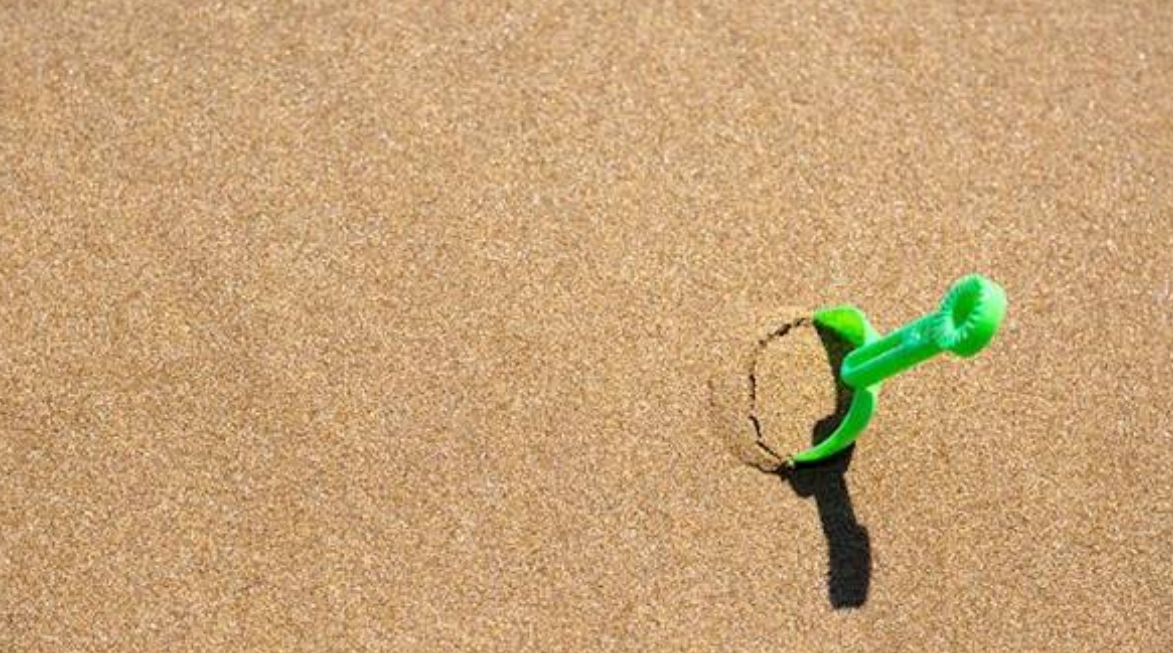
“The children arrive at three in the afternoon with pails and shovels and mothers. They leave the mothers sitting on wide white benches and toddle off to the sandbox.”
Joseph Roth states that “sand is something that God invented specially for small children, so that in their wise innocence of what it is to play, they may have a sense of the purposes and objectives of earthly activity. They shovel the sand into a tin pail, then carry it to a different place, and pour it out. And then some other children come along and reverse tye process, taking the sand back whence it came.”
I once witnessed this archetypal manifestation of the universal—if not always conscious—earthly activity with rapt attention. A small boy was engrossed in the laborious task of digging a hole in the sand, at some point on the vast beach of Bournemouth. He dug and dug, piling the quarried sand around the rim of the tiny pit. The lad, however, was interrupted by a spirited pet dog that wanted to play—not at digging, but at fetching a stick. The boy would, then, throw the stick for the dog and resume his digging. The dog, racing back with the stick, would jump into the hole, dragging a large amount of sand in with it. The boy tossed the stick and hastened to clear the hole; the dog eagerly fetched the stick, bringing all the sand right back into it.
It felt as though I had spent hours captivated by such a graceful and emblematic spectacle. At times I was the boy, at times the dog, at times the sand—now outside, now inside the hole—but, invariably, I was the repetition and the ultimate fruitlessness of the earthly activity.
Rare are the moments of clarity when we confront the true nature of our ceaseless bustle on this planet. These insights stay with us forever, allowing us to instantly recognize the metaphors and representations offered by others who have also managed to break through the bubble of senseless repetition.
Whenever I find myself distressed by a thankless, unending, fruitless task, I tell myself: stop digging, drop the stick; whether outside or inside, nothing will remain as it is— all is transitory; all is impermanent. Of course “one must imagine Sisyphus happy”, the struggle itself toward the heights is enough to fill his heart, but, once in a while, he can sit on the boulder and contemplate the horizon, without pretense.


